Synopsis
A shell on OpenBSD and a shell on Debian GNU/Linux can run the same frequency report. How did two different operating systems come to accept the same vertical bar? Some systems inherited Unix source code. Other projects deliberately implemented familiar interfaces. Standards later gave implementers a written definition of how those interfaces should behave. Follow those three kinds of connection through the two maps below.
From a shared machine to a shared set of tools
In 1969, Ken Thompson and colleagues at Bell Laboratories began what became Unix on a small PDP-7 computer. The immediate aim was to recover the interactive working environment the group had enjoyed on a larger shared machine. By November 1971, the first Unix Programmer’s Manual described a system in daily use. Its contents include a shell and separate entries for individual commands. That organization survives in the manual pages installed on modern systems. Dennis Ritchie’s account · The first edition of the manual
The shell acquired pipes later. Ritchie dates the implementation to 1972 and credits Douglas McIlroy with pressing for a way to connect programs. Pipes gave existing utilities a new use. A sort program could supply a counting program without either program knowing the other program’s name. The early shell notation went through several revisions before the vertical bar became familiar. Ritchie on the evolution of pipes
Follow the source code
In this map, a solid arrow follows source code from an earlier system into a later project or release. Dates mark events named in the text. The branches show selected transfers over many intervening versions.
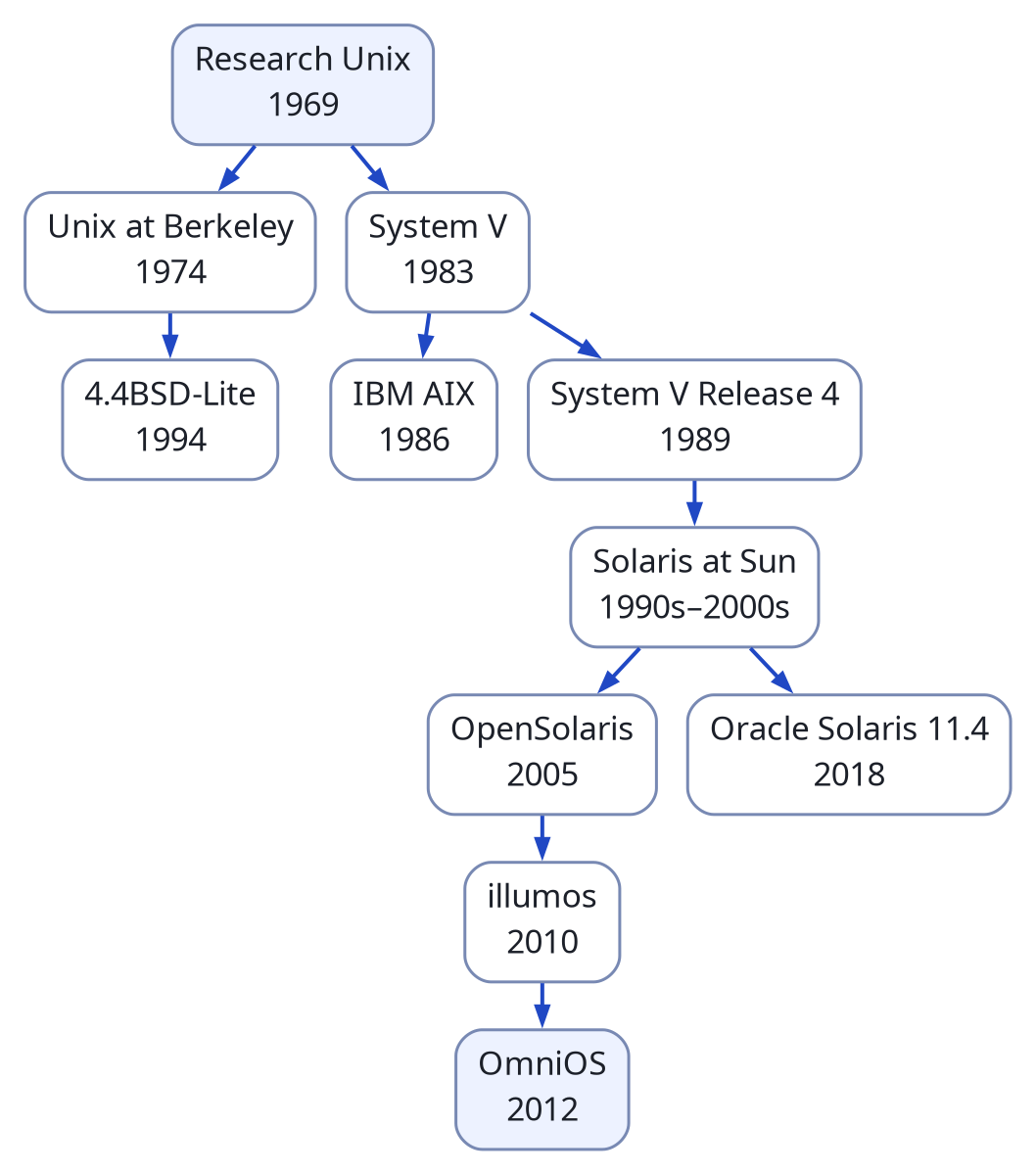
Read solid arrows in the direction of shared code. Oracle Solaris and OmniOS have a common Solaris history and separate releases.
Berkeley distributions
In January 1974, the University of California, Berkeley, installed a tape of Fourth Edition Unix from Bell Labs. Berkeley programmers could read the implementation, adapt it to local hardware, and send their additions to other sites. Early Berkeley Software Distribution (BSD) tapes carried programs including a Pascal compiler and the editor ex. The second distribution included vi, the editor used in Read, edit, and find text. Marshall Kirk McKusick’s account of Berkeley Unix
The distribution eventually grew into a complete system. In June 1994, Berkeley released 4.4BSD-Lite under terms that permitted source and binary redistribution. FreeBSD and NetBSD incorporated that code into their own systems. OpenBSD also traces its system to 4.4BSD. Each project maintains its own releases, utilities, and manual pages. McKusick on the 4.4BSD-Lite settlement and releases · OpenBSD project introduction
System V and the workstation
AT&T announced support for System V in 1983. One commercial branch reached IBM workstations in 1986 as the Advanced Interactive Executive (AIX). IBM supplied the operating system for its own hardware. Sun’s Standards Conformance Guide, chapter 1 · IBM’s account of AIX and System V · IBM Research on the 6150 workstation
In 1989, AT&T and Sun announced System V Release 4. The release brought together features from earlier System V, Berkeley Unix, SunOS, and Xenix. Sun used Release 4 as the foundation for SunOS 5 in its Solaris product. An application compiled for SunOS 4 could require porting or a compatibility package on SunOS 5. The distinction mattered even to customers who bought both systems from the same vendor. Sun’s account of Release 4 · Sun’s Binary Compatibility Guide
From Solaris to illumos and OmniOS
In 2005, Sun made Solaris source available through OpenSolaris. Garrett D’Amore announced illumos in 2010, and the project carried the OpenSolaris operating system code forward. OmniOS built a distribution around illumos and made its first public release in 2012. Oracle continued its own Solaris line and released Oracle Solaris 11.4 in 2018. That shared ancestry explains why an administrator may recognize the service tools on both systems. Consult the guide for the installed release before interpreting the results. The illumos project history · OmniOS first-release notes · Oracle Solaris 11.4 announcement
Follow an interface across implementations
In September 1983, Richard Stallman announced the GNU project with the goal of building a freely shareable, Unix-compatible system. The expansion “Gnu’s Not Unix” contains the project name itself. In 1991, Linus Torvalds released an early Linux kernel. Its release notes distinguish the kernel source from the Bash shell included for testing. A kernel manages resources and runs processes. The shell, compilers, libraries, and utilities supply much of the working environment above it. The Debian project began in 1993 and assembled a GNU/Linux distribution from components developed by multiple projects. The GNU announcement · Linux 0.01 release notes · The Debian project history
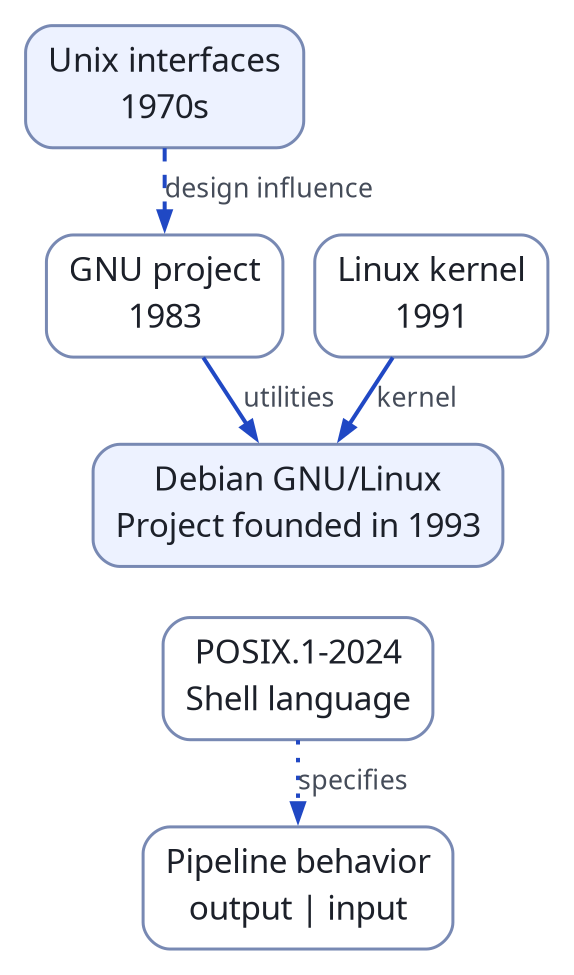
A dashed arrow marks a design influence. Solid arrows identify incorporated software. The dotted arrow connects a written standard to the behavior it specifies.
The Portable Operating System Interface (POSIX) gives programmers another way to follow a feature. The original 1988 standard addressed system interfaces. The 2024 edition also specifies shell syntax and utilities. Its shell language describes how a pipeline connects one command’s standard output to the next command’s standard input. Separate shells can implement that rule and still offer different extensions. A successful pipeline demonstrates that particular behavior. Formal conformance covers a much larger set of requirements. POSIX preface · POSIX shell pipelines
To identify a command on an inherited machine, start with its purpose. For a shell operator such as |, consult the shell specification and the local shell manual. For a service manager or package tool, begin with the release-specific OmniOS or Oracle Solaris guide. The history explains both the family resemblance and the need for separate manuals.